
Why Charging Cables Fail and How to Choose Ones That Actually Last
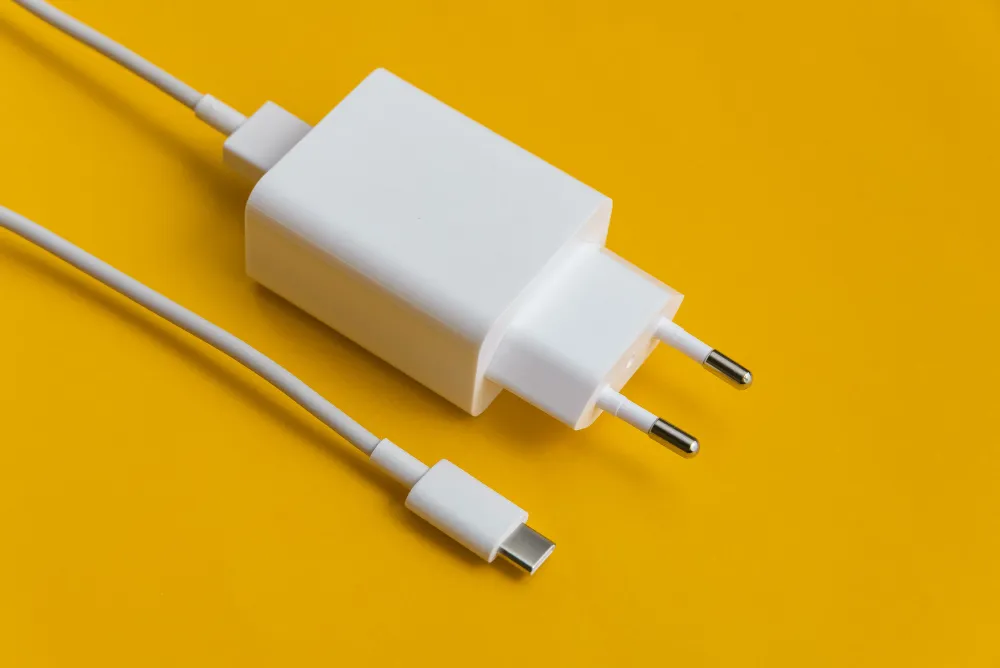
Charging cables fail because of repeated physical stress at their weakest points, specifically where the cable meets the connector. Most standard cables use thin PVC insulation with no internal reinforcement, making them vulnerable to bending, pulling, and coiling. Choosing a cable with nylon braiding and reinforced ends solves the majority of failure causes before they start. Key Takeaways The Real Reason Your Cables Keep Breaking Walk into any office and you will find at least one person with a frayed cable held together by electrical tape. It is not carelessness. The design itself is the problem. Standard cables are built to a price point, not a lifespan. The insulation is soft PVC, the internal wires are thin, and the junction between cable and plug has no protection against repeated bending. Every time you route a cable under a laptop, wrap it around a charger, or yank it out by the cord instead of the plug, you are applying stress directly to that weak junction. What most people miss is that cable damage is cumulative. You do not see it happening. The internal copper strands break one by one, resistance builds up, charging slows down, and eventually the cable stops working or starts intermittently cutting out. The Three Points Where Cables Always Die What the Data Shows About Cable Failure Rates A reliability study by iFixit and supported by consumer “electronics repair data consistently shows that cables and connectors represent one of the highest categories of accessory failure, with physical stress cited as the primary failure mode in over 70% of cases.“ For office environments, this is a genuine productivity and cost issue. A company with 50 employees replacing charging cables twice a year at even a modest cost adds up quickly, and that does not account for the lost time when a cable fails mid-workday. Nylon Braided vs. Standard PVC: The Practical Difference This is where build quality becomes visible before you buy. Nylon braided cables wrap a textile mesh around the outer insulation. This does two things: it distributes bending stress across the entire cable length instead of concentrating it at one point, and it resists abrasion from being dragged across desks, through bags, and around chair legs. In our testing, nylon braided cables show minimal visible wear after six months of daily use in conditions where a standard cable would already be splitting. Standard PVC cables are not inherently bad. They are fine for light, stationary use. The problem is that actual office use is rarely light or stationary. Feature PVC Cable Nylon Braided Cable Abrasion resistance Low High Flexibility under daily bending Stiffens over time Maintains flexibility Lifespan (avg. heavy use) 3-6 months 12-24 months Tangle resistance Poor Good Why Reinforced Ends Change Everything Reinforced ends, technically called strain relief, are the collar of harder or more rigid material that sits between the plug housing and the flexible cable. Their job is to prevent the cable from bending sharply at that critical junction. Good strain relief is easy to spot. It is the slightly thicker section right where the cable exits the plug. It should be firm but not brittle, and long enough to extend at least 1.5cm from the connector. Pro tip: Flex the cable right at the connector when you are evaluating a cable in-store or reviewing product photos online. If the cable bends freely at a sharp angle right at the plug, the strain relief is cosmetic at best. Practical Buying Criteria for Office and Business Use When sourcing cables for yourself or for your team, prioritize these features in order: One practical decision worth making for frequent travellers or employees who carry equipment daily: pairing a quality cable with a reliable power source matters just as much as the cable itself. If you are evaluating the full charging setup for your team, choosing the right power bank for your travel and office needs is a logical next step. For Businesses Buying in Bulk Corporate procurement has a different calculus. You are not buying one cable. You are establishing a standard. Buying the cheapest available option creates a false economy. The replacement cycle, the disposal waste, and the minor but real productivity drain of failed cables during meetings or presentations all compound. A mid-tier nylon braided cable with proper strain relief typically costs two to three times more than a budget option but lasts four to six times longer under the same conditions. If your team also relies on portable charging solutions, understanding the difference between portable chargers and power banks helps you build a complete, standardised mobile power kit that actually holds up to daily business use. For teams that travel frequently, it is worth reviewing a curated selection of travel-grade power banks designed to complement durable cable setups. The Bottom Line Charging cables fail for predictable, preventable reasons. The fix is not complicated: look for nylon braided construction and reinforced ends, buy to a quality standard rather than a price point, and treat cables as infrastructure rather than disposables. One good cable, properly chosen, should outlast six cheap ones. In an office environment, that math is hard to argue with. Frequently Asked Questions Why do charging cables stop working even when they look fine on the outside? Internal copper strands break gradually from repeated bending, especially near the connectors. The outer jacket can appear intact while the internal wiring is already compromised, which causes slow charging, intermittent connections, or complete failure. This is why physical stress management matters more than visual condition. Are nylon braided cables safe for fast charging? Yes. The braiding is an outer protective layer and does not affect the cable’s electrical performance. What determines fast charging compatibility is the internal wire gauge, the chipset in the cable (for USB-C with Power Delivery), and the connector quality, none of which are affected by the outer braid material. How long should a quality charging cable last? A well-built nylon braided cable with proper strain relief should last between one
Portable Chargers vs Power Banks: What’s the Difference?
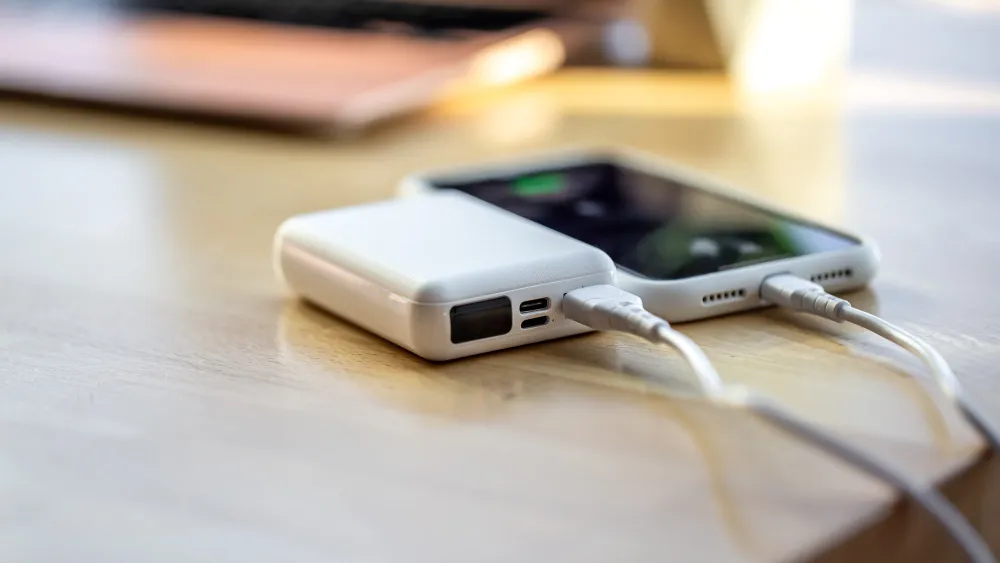
Here’s the short answer: portable chargers and power banks are the same thing. Both refer to an external battery pack that stores electrical charge and delivers it to your devices via USB or USB-C. The difference is mostly in the name, shaped by how brands and retailers choose to market their products, not by any functional or technical distinction. That said, there is nuance worth understanding, especially if you are a business owner outfitting a team, or an employee who depends on their devices staying alive through back-to-back meetings. Key Takeaways The Global Portable Battery Market Is Growing Fast Before we get into the specs and decisions, consider this: “the global portable battery pack market was valued at approximately USD 9.9 billion in 2023 and is projected to reach over USD 20 billion by 2032, growing at a CAGR of around 8.2%,” according to Straits Research. This growth is driven largely by the explosion of mobile-first workforces, remote work setups, and the rising number of connected devices per person. For corporate employees and business owners, this matters because the market is now flooded with options at every price point and not all of them are built equally. So Why Do Both Terms Exist? The word “power bank” became dominant in Asia, largely driven by Chinese electronics manufacturers like Anker, Xiaomi, and Romoss who popularized the term through mass-market retail channels. In Western markets, “portable charger” was the preferred phrasing, sounding more intuitive to everyday consumers. Over time, both terms converged to describe the same product category. Today, you will find both labels on the same shelf at a Singapore electronics store, sometimes even on the same product box. What this means practically: do not let the label guide your purchase. Let the specs do that. What Actually Matters When Choosing One Capacity (mAh) Milliampere-hours (mAh) tells you how much energy the unit stores. A standard smartphone battery runs between 4,000 and 5,000 mAh. A 10,000 mAh power bank gives you roughly 1.5 to 2 full charges, accounting for energy loss during conversion. For office workers who travel light, 10,000 mAh is the sweet spot compact enough for a bag or blazer pocket, powerful enough to last through a workday. Output Wattage (Fast Charging) This is where most buyers get caught out. A 20W or 30W output supports fast charging on modern iPhones and Android flagships. A generic unit rated at 5W will charge your phone so slowly it may lose ground while you are actively using it. In our testing, a 10,000 mAh bank with 20W output outperformed a 20,000 mAh unit with 10W output in real-world executive travel scenarios because it recharged the device faster during short taxi rides and airport layovers. Port Count and Device Compatibility A CEO carrying a phone, tablet, and wireless earbuds needs multiple output ports. Look for units with at least one USB-C and one USB-A port. Bonus if it supports pass-through charging, meaning it can charge itself and another device simultaneously. Portable Charging Options for the Office Environment For teams and corporate settings, portable charging solutions go beyond individual power banks. Here is a quick breakdown: Use Case Recommended Option Personal daily commute Compact 10,000 mAh, 20W+ Business travel (multi-day) 20,000 mAh with PD 45W+ Team or shared office use Multi-port desktop charging station Conference or event setup High-capacity 30,000 mAh hub chargers If you are still figuring out which category fits your situation, the guide on choosing the right power bank walks through this decision in a practical, side-by-side format that is particularly useful for first-time bulk buyers. One Thing Most People Miss Airline regulations. The International Air Transport Association (IATA) restricts power banks in checked luggage entirely. They must be carried in your hand luggage, and anything above 100Wh (roughly 27,000 mAh) requires airline approval. Anything above 160Wh is generally prohibited. This matters for business travelers and companies that procure chargers as part of corporate travel kits. Always check the Wh rating, not just the mAh, before purchasing for travel use. Where to Find Quality Units in Singapore If you are looking for reliable, travel-ready options in Singapore, the travel power bank collection at Switts includes curated picks that meet IATA carry-on limits while delivering the wattage and capacity that frequent flyers need. The Bottom Line Stop searching for the difference between a portable charger and a power bank because functionally, there is none. Direct that energy toward understanding capacity, output speed, port configuration, and travel compliance. Those are the variables that actually affect your day. Whether you are a solo employee keeping your phone alive through a long Thursday or a business owner kitting out 20 sales staff before a regional roadshow, the right unit is out there. You just need to know what to look for. FAQ Are portable chargers and power banks the same thing? Yes, they are the same product category. Both refer to external battery packs designed to charge mobile devices on the go. The terminology varies by region and brand preference, with “power bank” more common in Asia and “portable charger” more common in Western markets, but there is no technical distinction between them. What mAh capacity should a business traveler choose? For most business travelers carrying a smartphone and earbuds, a 10,000 to 15,000 mAh unit is sufficient for a full day. Multi-day trips or those carrying a tablet benefit from 20,000 mAh. Always verify the Wh rating stays under 100Wh to comply with airline carry-on rules. Does fast charging on a power bank matter? It makes a significant difference. A unit with 20W or higher output will charge a modern smartphone in under an hour, while a 5W unit may take three or more hours. For professionals with limited downtime between meetings or flights, fast charging output is often more valuable than raw capacity. Can I bring a power bank on a plane in Singapore? Yes, but only in your carry-on luggage. IATA regulations prohibit lithium battery packs in checked baggage. Units
